
Click to listen to relaxing piano music from the 1800s while learning about Lucy's House.
History of Lucy's House
In 1837, Thomas Austin custom built this home on land purchased from Owen Brown. Lucy Lake moved in, becoming the first owner of this beautiful home until 1877. From there, Lucy plied her trade as Hudson's local seamstress for 34 years, noted as the sole owner of the home even when women had not yet been given the right to own property. Lucy lived/owned in the Austin-Lake house with her mother, Lucinda Hurn Markillie, and her adoptive daughter, Mattie. Lucinda is known for writing a journal on her experience emigrating from Lincolnshire, England aboard the Westmoreland, a well-known sail ship during the 1800s. This historically significant journal is beautifully penned and today, the original leather-bound pages rest in the Hudson Library Historical Archives where scholars study it as they research early 1800s immigration.


Lucy Lake's adopted daughter, Mattie Leighton/Lighton Lake. She was adopted by Lucy in 1854 after the death of her parents. Tragically, she only lived until she was 27 years old.

In the late 1800s, Annie and Walter Walsh operated a saloon on Historic Main Street, after the deaths of Lucinda Hurn Markillie in 1850 and Lucy Lake in 1877. However, records show that the house was maintained as a private residence until 1955, at which time it became office space for various businesses. When Lucy moved to Ohio with fellow Hudsonites David Hurn and William Doncaster, she became a staple to the community. As one of the main merchants in downtown Hudson, Lucy had a valuable part in shaping the history of Hudson, Ohio.
Hudson, OH (c. 1890) photographed by Lucy Lake's half-brother, John Markillie, who is known for having the first camera in Hudson that photographed what is now known as the Markillie collection (c. 1861)
The Greek Revival Farmhouse has almost completely retained its original look, with the same build and layout as when Thomas Austin originally built it in 1837 with the cooperation of Tim Hudson, David Hudson's son. Some of its most charming features include a covered front porch and red brick and white wood fenced courtyard. Lucy's House has been painstakingly preserved and restored, and it remains just as lovely as it has always been, with the character and intricacies of a bygone era.
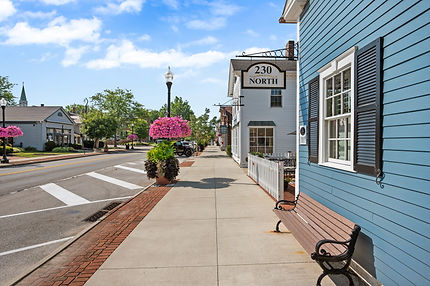

Today, Lucy's House rests in the Wooden Section of Downtown Historic Hudson, a treasure beyond its historical significance. The beauty of the home is most appreciated when remembering the early Hudsonites who journeyed to Ohio to make this small Midwestern town their home, and in doing so, made a history filled with hope, courage, and community, values that are still reflected in Hudson's community today. When staying at Lucy's House, enjoy being within walking distance to Historic Main Street's charming shops and restaurants, Western Reserve Academy (located across the street), Hudson Library & Historic Society, Heinen's grocery store, and many other unique locations. You are only just 5 miles from the Cuyahoga Valley National Park with easy access to Akron/Cleveland Connectors, you can easily explore Northeast Ohio and all of the history and beauty it has to offer!
James W. Ellsworth gifted the clocktower to Hudson, Ohio in 1912, and the tower has become an everlasting symbol of Hudson since then. As the clocktower is such a big part of the culture of Hudson, many diligent hands have worked together over the years to maintain its function and beauty. One of the most notable clock masters of Hudson was Percy Dresser, the town marshal. Percy began winding the one and a half ton weights in 1935 and faithfully carried out this duty until 1950. Tax and legal note that from 1922 to 1955, Percy Dresser called 230 North Main Street home for 33 years as sole owner, and thus Lucy's House became even more significant to the history and culture of Hudson. When walking by, don't miss the clock tower's three water sources: one constructed for animals, one for small pets, and one for Hudson locals.

